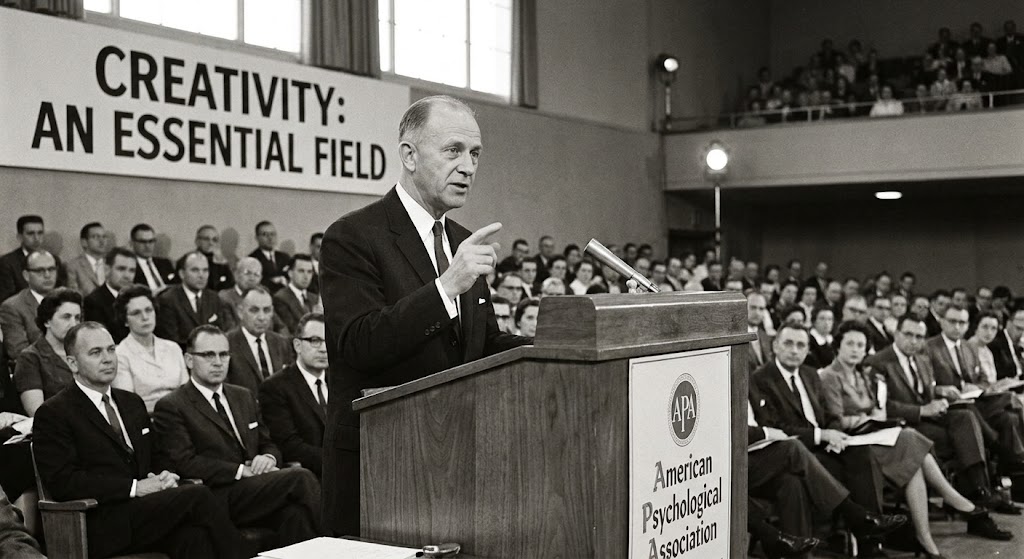
In 1950, J. P. Guilford used his presidential address to the American Psychological Association to make an uncomfortable point: creativity was an essential field that psychology had barely touched, accounting for just 0.2% of all psychological research. Half a century later the picture had flipped — more than 10,000 papers on creativity in a single decade — but at an unexpected cost. When Plucker, Beghetto and Dow (2004) examined 90 articles with “creativity” in the title, only 38% explicitly defined what they meant by it.
Against that background, James C. Kaufman and Ronald A. Beghetto published a short but ambitious paper in the Review of General Psychology in 2009. Their goal was to move past the classic split between everyday creativity (little-c) and eminent creativity (Big-C). The Four C model adds two categories — mini-c and Pro-c — to describe more precisely where creativity happens and how it develops over a lifetime.
The Trouble With a Two-Box Model
Most research on creativity, the authors note, follows one of two paths. One studies eminent creativity — geniuses, works that last, Pulitzer Prize winners — and is usually called Big-C. The other looks at the everyday creativity found in nearly everyone: turning leftovers into a new dish, or finding a clever fix for a scheduling problem at work. That is the territory of little-c, where most studies with students and children sit.
The distinction is useful, Kaufman and Beghetto acknowledge, but it hides important differences. Under the little-c label, an eighth-grade art student who discovers a personally meaningful use for a shading technique sits next to an amateur artist who has won a local competition with techniques of her own. And between everyday and eminent creativity there is a gap: the jazz musician who makes a living playing — but is clearly no John Coltrane — fits neither box.
Big-C and little-c: The Two Classic Poles
Big-C covers clear-cut, eminent creative contributions. The authors point to Dean Keith Simonton’s work on creative genius and to Csikszentmihalyi’s systems model, in which creativity emerges from the interaction of a domain, a field of gatekeepers — teachers, editors, critics — and a person. Simonton’s research on age and achievement also suggests that Big-C output begins in a creator’s twenties, peaks somewhere around 40 and then gradually declines.
Little-c, by contrast, shows how widely creative potential is distributed. The authors place Amabile’s componential model — domain-relevant skills, creativity-relevant skills and task motivation — mostly at this level. The same goes for the definition offered by Plucker and colleagues: “Creativity is the interaction among aptitude, process, and environment by which an individual or group produces a perceptible product that is both novel and useful as defined within a social context” (Plucker et al., 2004, p. 90). Little-c has also helped dismantle myths, such as the idea that only certain people can be creative, or that creativity goes hand in hand with deviance.
Mini-c: The Creativity of Learning
The first addition is mini-c, a category Beghetto and Kaufman had proposed in 2007. They define it as the novel and personally meaningful interpretation of experiences, actions and events. It is the creativity built into learning itself: what happens when a student makes sense of a concept in their own way or comes up with a new metaphor. The authors tie it explicitly to the Vygotskian view of development, in which everyone has creative potential that grows from transforming — not merely copying — the cultural tools they receive.
Their example makes the case well. A fourth-grade student may have original, personally meaningful ideas about whether Pluto should count as a planet. If little-c is the only alternative to Big-C, those insights end up lumped together with an astronomy graduate student’s, or even a professional astronomer’s. Judged against that standard, the student’s creativity is overlooked or discouraged. Mini-c protects that potential, and it reminds us that an idea not yet expressed in any tangible form can still be a creative act.
Mini-c, the authors stress, is not just for kids. Openness to new experiences, active observation and a willingness to be surprised — the “beginner’s mind” — characterize all creators, and they are the seed of work that may one day be widely recognized.
Pro-c: Professional Creativity Without a Home
The second addition tackles the opposite problem. Big-C almost always requires a posthumous verdict: it can take decades to know whether a body of work will last, and history is full of creators celebrated in their day and forgotten since. The authors contrast Jean-Louis-Ernest Meissonier, whose work was presented to Napoleon III, with Manet, who became legendary. If Big-C is the only category above little-c, studying living creators with any confidence becomes nearly impossible.
Pro-c represents “the developmental and effortful progression beyond little-c (but that has not yet attained Big-C status)” (p. 5): anyone who reaches professional-level expertise in a creative area. The idea fits research on expertise, which suggests that around ten years of intensive preparation are needed to reach expert level in a domain. Kaufman and Beghetto illustrate it with Marcus, a fictional novelist with four well-received books. Filing him under little-c diminishes what he has earned; calling him Big-C is premature.
A Trajectory, Not a Ladder
The model sketches a possible developmental path rather than a lock-step progression. Nearly everyone starts with mini-c. With practice and encouragement, people may reach little-c and — after years of formal training or an informal apprenticeship with a mentor — Pro-c. Some advance in one area and stay at little-c in others: a Pro-c chef might happily write poetry as a hobby. And some skip steps entirely: Einstein made some of his most profound contributions while working at the Swiss Patent Office, not as a professional physicist.
The authors walk through the whole model using Helen Keller’s life. Her realization that the sign traced into her palm meant “water” was a mini-c moment; her education and autobiography were little-c; her activism was Pro-c. The point at which she reached Big-C is harder to pin down — as it is for anyone — though she was a clear candidate in old age. The model also names different end points: reflection, or creativity for its own sake; stasis, for some professionals; and, at the very top, the category of “legend”, reserved for figures such as Newton and Einstein.
What Changes When You Separate Four Levels
The model’s practical payoff is that it untangles questions that used to be mixed together. How to assess creativity, for instance, depends on the level. At mini-c, self-assessments and microgenetic methods make the most sense. At little-c, teacher, parent and peer ratings, psychometric tests such as the Torrance tests and the Consensual Assessment Technique all have a role. At Pro-c, expert judgment, citations and prizes take over; at Big-C, major honors and historiometric measures.
The model also sheds light on open debates. The authors argue that creativity becomes more domain-specific as one moves from mini-c toward Big-C, and that intrinsic motivation matters most at the mini-c and little-c levels, where interest is still fragile and external rewards can crowd it out. They also cite a study by Beghetto (2006) in which teachers’ positive feedback on students’ creativity was the strongest unique predictor of students’ beliefs about their own creativity.
A Framework That Keeps Creativity From Getting Lost
Kaufman and Beghetto close by warning of a double risk. Thinking only in terms of little-c and Big-C can mean overlooking children’s creative potential while also downplaying the work of professional creators. The Four C model offers the right level of specificity to situate earlier theories and research, and it points to the aspects of creativity that still need investigation.
For researchers, the model is an invitation to state which level of creativity they are actually studying. For educators, the message is direct: most classroom creativity is mini-c, and recognizing it — rather than measuring it against expert standards — is what allows it to grow. For professionals, Pro-c validates a path that takes years of deliberate practice. That is why the creativity course spends its very first week on recognizing the different types of creativity: it is the starting point for developing it with method.
Original source: Kaufman, J. C., & Beghetto, R. A. (2009). Beyond big and little: The Four C model of creativity. Review of General Psychology, 13(1), 1–12. https://doi.org/10.1037/a0013688
Learn creativity with a method
Mario Miqueles’ creativity course: 20 weeks, 4 units and a final project, online or as a book.