
Tags: Creativity Research · Developmental Psychology · Sociocultural Theory Section: Creativity Research | masterincreativity.com Based on: Alessandroni (2017)
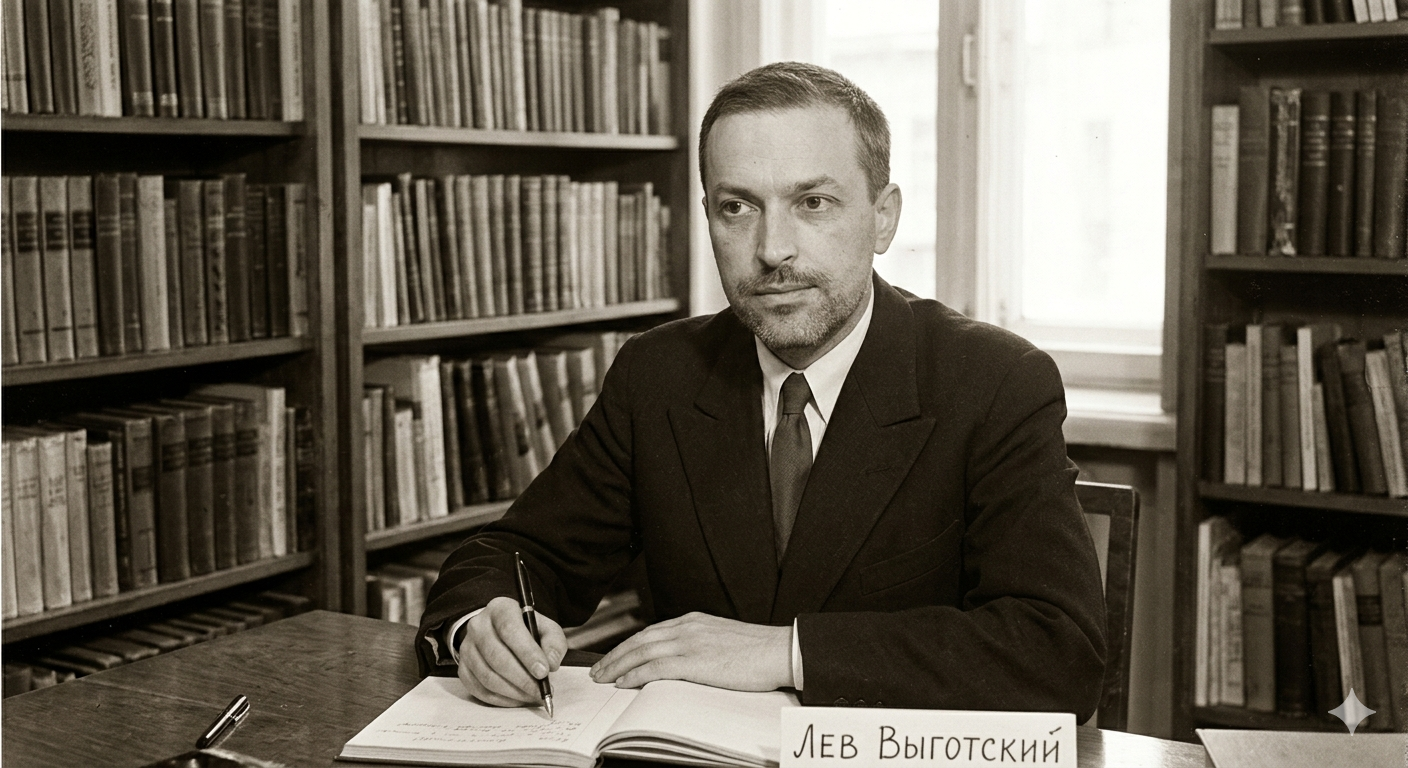
The dominant paradigm in creativity research has long centred on the individual: the exceptional mind that generates novelty in spite of — or beyond — its social context. Lev S. Vygotski’s theoretical framework, first articulated in 1931 and reexamined in a 2017 paper by Nicolás Alessandroni, offers a fundamental challenge to this assumption. For Vygotski, creativity is not the expression of an autonomous inner capacity. It is a higher psychological function whose origins, structure, and developmental trajectory are constitutively sociocultural.
Alessandroni’s paper — Imaginación, creatividad y fantasía en Lev S. Vygotski: una aproximación a su enfoque sociocultural — situates Vygotski’s account of adolescent creativity within the broader architecture of Historical-Cultural Theory, tracing the conceptual lineage from the notion of Higher Psychological Processes (HPPs) through the mechanisms of internalisation, mediated action, and autoregulatory control. The result is a reading of creativity that is genuinely developmental, longitudinal, and resistant to individualist reduction.
Creativity as a Higher Psychological Process
Within Historical-Cultural Theory, HPPs designate those specifically human psychological functions that originate in, and remain dependent upon, socially organised activity. They are characterised by the use of semiotic mediating instruments, a degree of conscious control, and a developmental logic that is irreducible to biological maturation. Language is the paradigmatic case; creativity, imagination, and fantasy occupy the same register.
The relationship between culture and these processes is not one of linear causation — culture does not simply trigger or modulate creativity from the outside. The relationship is dialectical and co-constitutive: as the subject appropriates cultural tools and practices, those tools reorganise the structure of psychological functioning itself. Internalisation, in this framework, is not the passive reception of external content but a generative process that creates new forms of consciousness.
This theoretical grounding allows Alessandroni to situate Vygotski’s approach in direct opposition to what he calls the hegemonic individualist model — a research tradition in which, as Glăveanu (2010) aptly summarises, “society and culture act repeatedly as the ‘villains’ against which the creator struggles.” For Vygotski, society and culture are not obstacles to creative development. They are its conditions of possibility.
The Adolescent Transformation: Imagination Meets Conceptual Thought
The analytical centrepiece of the 1931 text is Vygotski’s account of how creativity is qualitatively transformed during adolescence. His central hypothesis is that two previously independent psychological functions — imagination (rooted in the concrete visual thinking and play of childhood) and conceptual thought (the capacity to operate with true, abstract concepts) — undergo a process of psychic reorganisation during the transitional period of adolescence that allows them to become functionally intertwined.
The traditional psychological view held that imagination was the primary, elementary function governing adolescent mental life — essentially an expression of sexual maturation. Vygotski rejects this model on two grounds. First, it treats imagination as a fixed, undifferentiated function rather than one subject to genetic transformation. Second, it systematically ignores the relationship between creativity and intellectual life, reducing the former entirely to the emotional sphere.
Against this, Vygotski proposes that during adolescence, imagination becomes intellectualised — liberated from its dependence on concrete perceptual material — while conceptual thought becomes creativised, acquiring a generative, combinatory dimension it previously lacked. This dialectical convergence does not dissolve the distinction between the two functions; they approach each other without ever fully merging. The outcome is a qualitatively new psychological configuration unique to the adolescent period.
“It is for oneself, in the mind, that poems and novels are produced, dramas and tragedies enacted, elegies and sonnets composed.” — Vygotski, 1931
Crucially, this transformation has a genetic trajectory. Vygotski traces the roots of adolescent imagination back to children’s play — not as a biological precursor, but as a socially situated, culturally mediated activity. The child who builds castles in sand and the adolescent who constructs them in imagination are engaged in structurally analogous processes: the adolescent’s fantasy is the internalised, abstracted continuation of that earlier concrete activity, now elevated to a higher functional level through its contact with true concepts.
Autoregulation and the Private Life of Fantasy
A further dimension of Vygotski’s analysis concerns the autoregulatory function of adolescent fantasy. Because adolescent imagination operates with conscious control — a hallmark of advanced HPPs — it acquires the capacity to serve as an instrument of psychological self-regulation, particularly in the emotional domain.
Adolescent fantasy, Vygotski argues, functions as a form of wish-fulfilment and compensatory activity: it provides symbolic resolution for needs, tensions, and desires that remain unsatisfied in external life. Significantly, this process is characteristically private — the adolescent conceals rather than shares these fantasies — a structural parallel to Vygotski’s account of private speech as the internalised, self-directed form of social language. In both cases, a function that originates in social interaction is reconstructed at the intrapsychological level as a tool for self-governance.
The Continuing Relevance of a Sociocultural Framework
Alessandroni’s paper closes with an argument about contemporary relevance that deserves serious attention. Vygotski’s premise — that every psychological function appears first at the social level and only subsequently at the individual level — implies that the specific sociocultural conditions of any historical moment are not merely contextual background for creative development. They are actively constitutive of its form, content, and possibilities.
Writing in 1931, Vygotski could not have anticipated the degree to which the automation of routine cognitive labour would render creative capacity not merely valuable but structurally necessary. Yet his framework is precisely suited to thinking through this situation: if creativity develops through participation in culturally organised systems of activity, then the design of those systems — educational environments, institutional structures, collaborative practices — is not incidental to creative capacity. It is its primary site of production.
For researchers, educators, and practitioners working at the intersection of creativity and human development, the sociocultural tradition inaugurated by Vygotski offers analytical resources that no individualist framework can provide: a developmental account of how creativity changes across the lifespan, a relational conception of its conditions of emergence, and a theoretical basis for understanding creativity not as a trait to be measured but as a function to be cultivated — always in relation, always in context.
Original source: Alessandroni, N. (2017). Imaginación, creatividad y fantasía en Lev S. Vygotski: una aproximación a su enfoque sociocultural. Actualidades en Psicología, 31(122), 45–60. https://doi.org/10.15517/ap.v31i122.26843