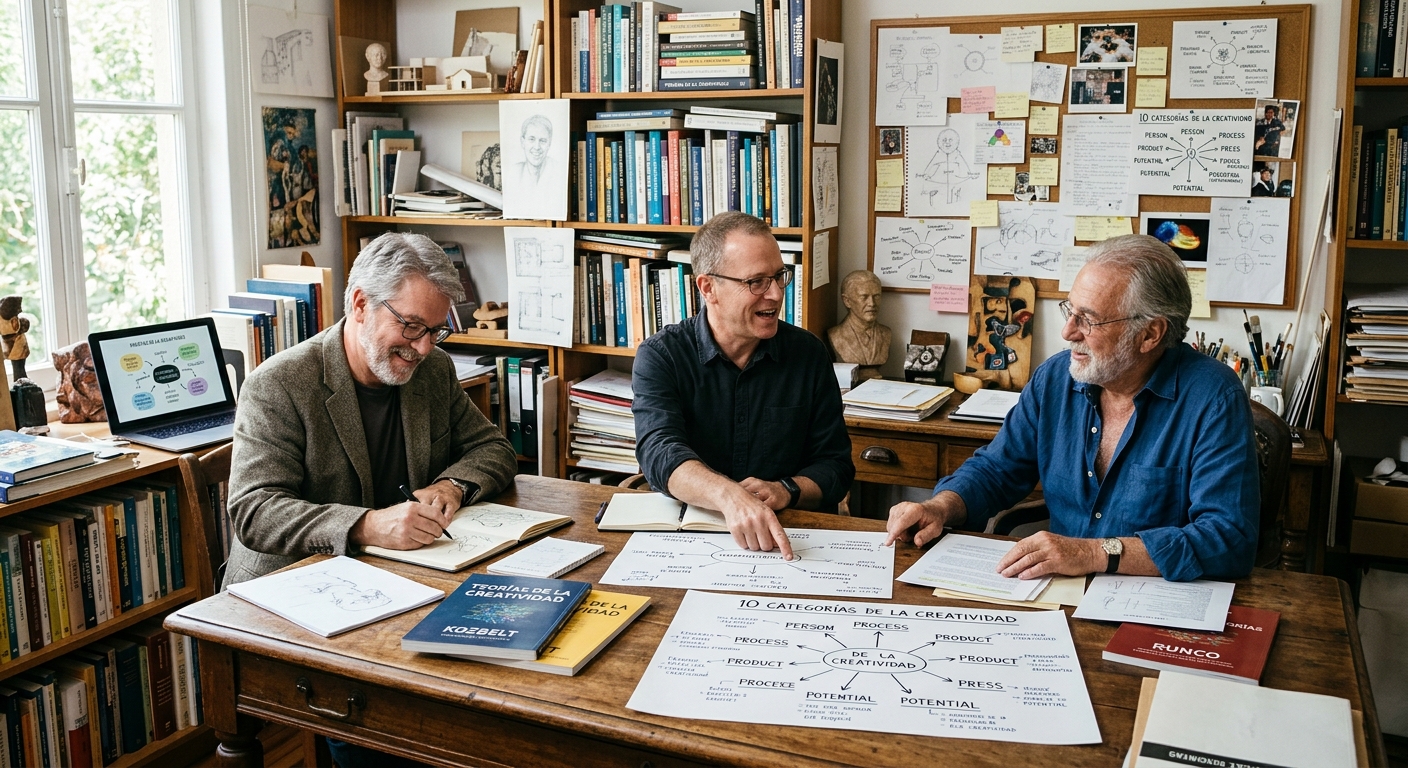
Autonomy is good for creativity, but too much of it leaves a person with no direction and no focus. Divergent thinking, which sends ideas off in many directions, lies behind many creative ideas, yet too much divergence produces irrelevant ones that are not both original and useful. With this case for moderation, Aaron Kozbelt, Ronald A. Beghetto and Mark A. Runco open “Theories of Creativity,” the second chapter of The Cambridge Handbook of Creativity (2010).
The authors carry the same principle into science: to understand creativity in all its richness, no single theoretical perspective should be emphasized at the expense of the others. They call it pluralism. So rather than offering a new theory, they draw a map: they sort contemporary theories into ten categories and compare them with two tools, levels of creative magnitude and the six P’s.
From Mini-c to Big-C: Four Levels of Creativity
The most common distinction sets Big-C creativity, the unambiguous cases such as Dickinson’s poetry, Coltrane’s jazz or Freud’s psychology, against little-c, the creativity of everyday life that almost anyone can reach: say, the novel way a home cook adds ingredients to a recipe, later praised by family and friends.
Like most dichotomies, the authors warn, this one can lack nuance. A painter who makes her living selling watercolors and teaching watercolor at a community college, a weekend watercolorist who gives his paintings away, and an elementary school student who gains new insights each time she combines shapes and colors all sit at different levels. None compares with Cézanne, Dürer or Kandinsky, but lumping them all together as little-c hides important differences.
That is why Kaufman and Beghetto (2009) added two categories, covered in detail in the study on the Four C model. Mini-c captures the most subjective and personal forms, which may never leave the mind of the person who has them. Pro-c describes professionals who are well beyond amateurs but have not reached eminence. The authors use these four levels to compare theories, with a caveat: “the use of categories to classify creative phenomena (no matter how precise or flexible) is always limited, potentially obscuring as much as clarifying the nature of creativity” (p. 24).
The Six P’s: Which Aspect Each Theory Explains
The second tool sorts theories by the aspect of creativity they focus on. Traditionally there were four P’s, and more recent versions added two:
- Process: the mental mechanisms at work while someone thinks or acts creatively.
- Product: works of art, inventions, publications. It is the most objective approach, since products can be counted and judged, but it says little about the process and nothing about potential not yet fulfilled.
- Person: traits that cut across domains, such as intrinsic motivation, wide interests, openness to experience and autonomy.
- Place (or press): the setting. Creativity tends to flourish when there are chances to explore and work independently, and when originality is supported and valued.
- Persuasion: creative people change the way others think, so they must be persuasive to be recognized as creative.
- Potential: what has not yet been realized. This P makes room for everyday creativity and for children who have most of what it takes but need educational opportunities to put it to use.
The 10 Categories of Theories of Creativity
With these tools, the chapter reviews ten categories and summarizes them in a table (pp. 27–28). By their primary assertion:
- Developmental: creativity develops over time, from potential to achievement, through the interaction of person and environment.
- Psychometric: creativity can be measured reliably and validly, is distinct from IQ, and varies by domain.
- Economic: creative ideas and behavior respond to “market forces” and cost-benefit analyses.
- Stage and componential process: creative work moves through stages or components, some linear and some recursive.
- Cognitive: the thought processes that generate ideas are the foundation of creative people and achievements.
- Problem solving and expertise: creative solutions to ill-defined problems come from a rational process that draws on general cognitive processes and domain expertise.
- Problem finding: creative people proactively explore, in a subjective way, which problems are worth solving.
- Evolutionary (Darwinian): eminent creativity results from evolution-like processes: the blind generation of ideas and the selective retention of some.
- Typological: creators differ along key individual traits that can be sorted into types.
- Systems: creativity results from a complex system of interacting factors.
How Ideas Emerge: Stages and Two Modes of Thinking
One of the most popular and enduring process theories is that of Wallas (1926). It begins with preparation, when a person gathers information and defines a problem. Then comes incubation, time away from the problem, at least consciously, followed by illumination, when a solution suddenly makes itself known, and finally verification, when the idea is tested. The model’s linearity has largely been discredited: more recent models accept that a person may cycle back, for example, to preparation.
Other theories study preparation as problem finding. Getzels and Csikszentmihalyi (1976) observed 31 college art students who arranged a set of objects and drew from them. The more creative students handled more objects before drawing and made more changes to the emerging drawing, and this exploratory behavior predicted their success in the art world years later.
Among cognitive theories, studies of creative cognition mostly draw on Guilford’s distinction between divergent thinking and convergent thinking, which seeks one correct or conventional answer. Both can play a part in the same creative effort, and together they yield ideas that are original and effective at once, as the article on divergent vs. convergent thinking explains.
Expertise, Chance and Two Kinds of Creators
Expertise-based theories argue that creative thought stems from ordinary cognitive processes, and that major achievements rest on domain-specific expert knowledge built over a decade or more of intensive study. Hayes (1989) found that 73 of 76 great composers needed at least 10 years of musical study before writing a masterwork; the exceptions came in years 8 and 9. This view acknowledges that “one simply cannot create a good symphony or theory of physics without enormous amounts of relevant background knowledge” (p. 34). Still, expertise is a necessary condition, not a sufficient one.
The Darwinian theory of Dean Keith Simonton, a strong candidate for the most comprehensive theory of creativity, describes two steps: ideas combine blindly, usually below awareness, and the most interesting combinations are elaborated into finished works, which other people then judge. In this model, creators have little control over the fate of their work, so mass production is the best strategy for anyone seeking eminence. Critics reply that it overemphasizes the role of chance.
Typological theories deal with differences between creators. Galenson distinguishes seekers, who begin without clear goals, proceed by trial and error and improve steadily with age, from finders, who prepare in detail, know their goals at the outset and, because they radically change a domain’s rules, often make a notable contribution early in their careers.
Where Is Creativity? Family, Setting and Systems
Developmental theories are, for the authors, among the most practical, because they suggest how to design environments in which children’s creative potential can be fulfilled. Studies of eminent people’s lives describe parents who exposed their children to diverse experiences and gave them a moderate amount of independence: they knew what their children were doing but were not overly restrictive.
In systems theories, Csikszentmihalyi stopped asking what creativity is and asked where it is. In his model, judgments of creativity emerge from three interacting components: the domain, the body of knowledge in a discipline at a given time; the individual, who acquires that knowledge and produces variations on it; and the field, the experts who decide which novelties are worth preserving for the next generation. The model brought “gatekeepers” into view, such as journal editors and gallery owners, who decide which contributions get the chance to be judged creative.
Moderation and Pluralism: What the Chapter Leaves Us
The authors end where they began. They do not necessarily call for a grand unifying theory; instead, they ask scholars to situate their theories in the wider landscape, acknowledge that their own assumptions are contested, and look for overlap with rival positions.
For researchers, the chapter is a guide to placing a theory: which level of creativity it explains, which P’s it brings to the foreground, and how it balances empirical rigor with more speculative ideas that can illuminate possibilities not yet experienced. For educators, it is a reminder that everyday creativity and students’ potential count too. For professionals, it shows that expertise takes years and that the field’s gatekeepers also decide what is recognized as creative. The article on what creativity is according to psychology covers its definition and main models.
In the creativity course, Week 3 is devoted to the basic theories of creativity.
Original source: Kozbelt, A., Beghetto, R. A., & Runco, M. A. (2010). Theories of creativity. In J. C. Kaufman & R. J. Sternberg (Eds.), The Cambridge handbook of creativity (pp. 20–47). Cambridge University Press.
Learn creativity with a method
Mario Miqueles’ creativity course: 20 weeks, 4 units and a final project, online or as a book.