Why do we have seasons? When Harvard’s Private Universe Project put that question to 23 Harvard graduates, alumni and faculty, 21 of them could not explain it. One had recently taken a course on the physics of planetary motion and still believed that summer comes because the Earth moves closer to the Sun. For Joseph D. Novak and Alberto J. Cañas, the case shows how hard it is to change an idea that was learned by rote — and why learners need tools that help them learn meaningfully.
That tool is the concept map. It was developed in 1972, in Novak’s research program at Cornell University, and in this technical report from the Florida Institute for Human and Machine Cognition (IHMC) — numbered 2006 and revised in 2008 — the two authors explain its origins, the learning theory behind it, and how to build and use good maps.
What a Concept Map Is
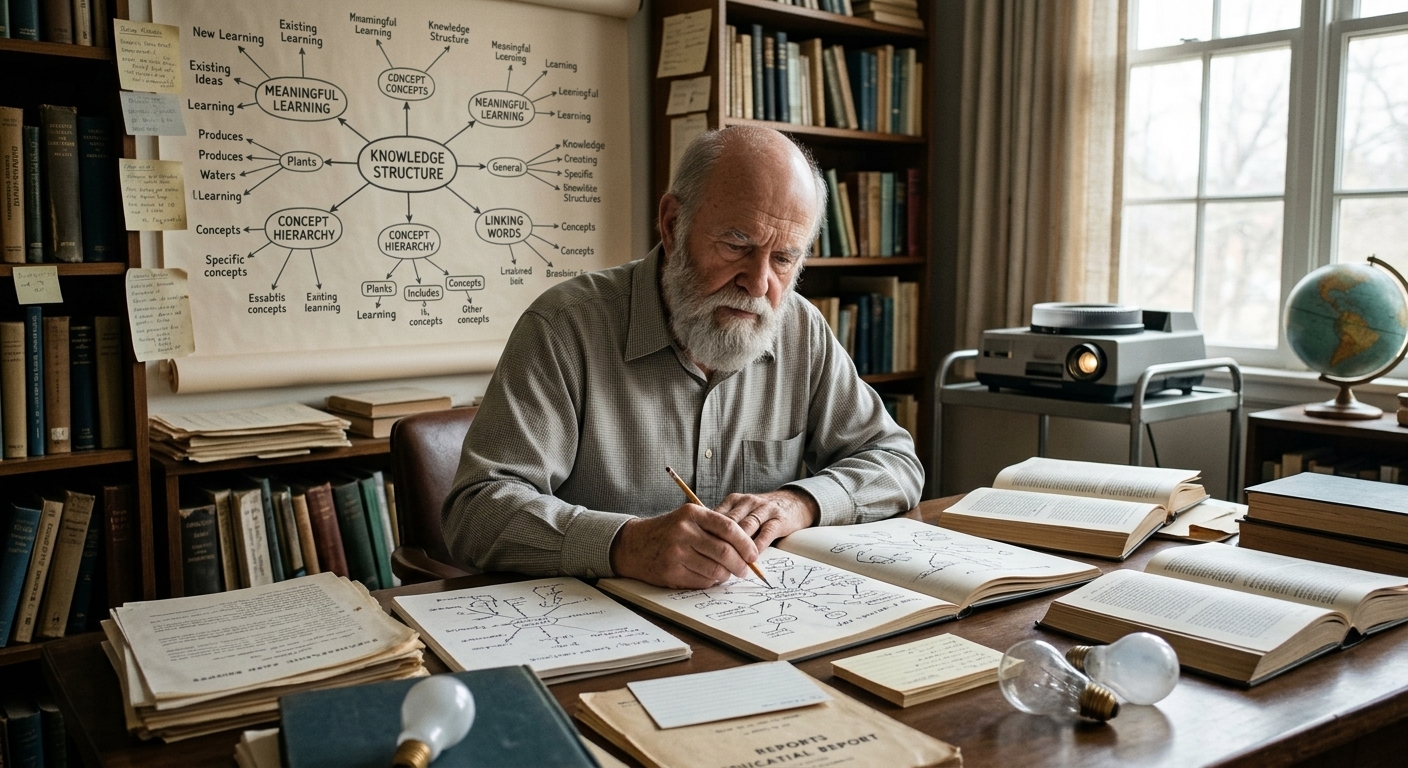
A concept map is a graphical tool for organizing and representing knowledge. It has two basic parts. Concepts sit inside circles or boxes, and the authors define a concept as a perceived regularity in events or objects, designated by a label — usually a word. Linking words, written on the line that joins two concepts, specify how they are related. Two or more concepts joined this way form a proposition: a meaningful statement, a unit of meaning.
Concepts are arranged hierarchically, with the most general, most inclusive ones at the top and the more specific ones below, so maps tend to be read from the top down. Because that hierarchy depends on context, each map is best built to answer one specific question: the focus question. The definition is completed by cross-links, which connect concepts in different parts of the map, and by specific examples, which clarify a concept’s meaning and are not boxed, since they are not concepts.
Rote Learning Versus Meaningful Learning
Concept maps were born out of necessity. Novak’s team was following changes in what a group of children knew about science, and found it hard to tell from interview transcripts what had changed in their understanding. The program was based on David Ausubel’s learning psychology, whose central idea is that we learn by assimilating new concepts and propositions into the concept frameworks we already hold. Representing that knowledge as a map was the way out.
Ausubel distinguished between rote learning and meaningful learning, which relates new knowledge to what the learner already knows. Meaningful learning requires three conditions: clear material, with examples the learner can relate to prior knowledge; relevant prior knowledge; and the learner’s own choice to learn this way rather than simply memorize. For the authors this is not a dichotomy but a continuum, and at its highest end lies creativity: “Creativity can be seen as a very high level of meaningful learning” (p. 4).
The difference matters. What is learned by rote tends to be quickly forgotten unless it is rehearsed a great deal, and it does not clear up faulty ideas, which persist. Working memory, moreover, can only process five to nine units at any one moment. That is why, Novak and Cañas argue, a concept map works as a scaffold that helps organize knowledge piece by piece. They also warn about a common confusion: inquiry alone does not guarantee meaningful learning. Unless students have at least a rudimentary conceptual understanding of what they are investigating, the activity may be little more than busy work.
Creating Knowledge Is Learning at a Very High Level
The report goes beyond the classroom. Novak has argued that creating new knowledge is nothing more than a relatively high level of meaningful learning, achieved by people who have a well-organized knowledge structure in a field and a strong emotional commitment to keep searching for new meanings. That is why, according to the authors, learners who struggle to build a good concept map are already engaged in a creative process, while rote learning cannot underlie creative thinking or novel problem solving.
On the map, that potential has a precise place. Two features facilitate creative thinking: the hierarchical structure of a good map, and the ability to search for and characterize new cross-links, which in the creation of knowledge often represent creative leaps. The authors offer a chemical analogy: concepts are like atoms and propositions are like molecules. Around 100 kinds of atoms make up an infinite number of molecules; in the same way, the roughly 460,000 words of the English language can be combined into an infinite number of propositions.
How to Build a Good Concept Map
Novak and Cañas lay out a clear sequence:
- Pick a familiar domain and a limited context: a segment of a text, a lab or field activity, or a problem you are trying to understand.
- Write a focus question that states clearly what problem the map should help resolve. Asking students to “make a concept map about plants” is not the same as asking “Why do we need plants?”: the question changes the kind of map they build.
- Identify the key concepts, usually 15 to 25, and rank them from the most general to the most specific. That list is the parking lot: concepts move out of it and onto the map as you find where they fit.
- Build a preliminary map, with sticky notes or with CmapTools, the software developed at the IHMC.
- Look for cross-links between different parts of the map, selectively and with precise linking words.
- Revise: a concept map is never finished, and good maps usually take three to many revisions.
The authors also flag two common mistakes. One is writing full sentences inside the boxes, which usually means a whole section of the map could be built from that statement. The other is the “string map,” a sign of poor understanding of the material or of a map that was never properly restructured. The hardest part, experienced mappers and researchers agree, is building the propositions: finding the linking words that clearly show how two concepts are related.
From the Classroom to Organizations
Concept maps are also an assessment tool. Unlike multiple-choice tests, which mainly measure rote recall, they reveal both the valid and the invalid ideas a student holds, and they can be as effective as more time-consuming clinical interviews for finding out what a learner knows before or after instruction. The authors also recommend having students work in small groups. They draw on Vygotsky, whose sociocultural approach is analyzed in another study on this site, to highlight the role of language and social dialogue in learning, and they note that because criticism is aimed at the map rather than the person, insecurity and the fear of embarrassment largely fall away.
Outside school, concept maps help plan courses and whole curricula — the report shows the map Cornell’s veterinary medicine faculty built to structure a revised curriculum — and capture the tacit knowledge of experts, the know-how they build up over years and struggle to put into words. When the IHMC team mapped what a cardiologist knew, an expert who had literally written the book on a diagnostic technology, the map exposed gaps: part of his knowledge appeared neither in his book nor in the interviews.
A Simple Tool, but Not a Simplistic One
At first glance, the authors admit, a concept map may look like just another way of putting information into a diagram. But when concepts are organized with care and propositions are formed with well-chosen linking words, “a good concept map is at once simple, but also elegantly complex with profound meanings” (p. 31). According to the report, concept maps have helped learners learn, researchers create new knowledge, administrators structure organizations, writers write and evaluators assess learning. Like any tool, they can also be misused.
For researchers, the report provides an explicit theoretical foundation: Ausubel’s psychology and a view of knowledge creation as a constructive process. For educators, the message is practical: always start from a focus question, ask for propositions rather than lists of concepts, and use maps to assess understanding, not memory. For professionals, a concept map is a way to make visible what a team knows but cannot quite explain. Visual tools like this one have their own place in the creativity course: its fourth unit is devoted to tools for idea generation, with mind maps in Week 14.
Original source: Novak, J. D., & Cañas, A. J. (2008). The theory underlying concept maps and how to construct and use them (Technical Report IHMC CmapTools 2006-01 Rev 01-2008). Florida Institute for Human and Machine Cognition.
Learn creativity with a method
Mario Miqueles’ creativity course: 20 weeks, 4 units and a final project, online or as a book.